This Is Me Album Back to Back Cover Art Drake
Architects: Showcase your next projection through Architizer and sign up for our inspirational newsletter.
A popular maxim, widely merely not definitively attributed to Elvis Costello, holds that "writing well-nigh music is similar dancing about architecture." In add-on to skewering music critics — a perennial punching bag — this joke asserts the ultimate integrity of each private art form. What is expressed in one medium, the logic goes, you cannot translate into another.
Album art presents an interesting claiming to Costello'southward formalist maxim. While a sleeve design cannot really tell y'all what the music inside sounds similar, it can become a office of the full work, bringing a visual component to the listening experience. In cases when architecture finds its fashion onto an anthology cover, these buildings also get bound upwardly with the music. When this is pulled off effectively, music and architecture can speak to each other in intriguing means.
As we put together this listing, we did a practiced amount of dancing about compages, or at to the lowest degree tapping our anxiety while considering the subtle, sometimes ingenious means musicians have played with architectural iconography over the years. What follows are just 15 examples of memorable album covers featuring architecture. This is far from a complete list, so delight share your own examples in the comments.
Spotify users: click hither to listen to the full playlist!

Via Facebook
Stars: The North (2012)
Regular readers of Architizer know how much nosotros honey Moshe Safdie's Habitat 67 housing circuitous. When it was unveiled at Expo 67 in Montreal, Safdie's arrangement of 354 identical prefabricated concrete housing units presented a challenging and original vision for the hereafter of urban living. In one manner, Habitat 67 represents an attempt to use principles of musical composition in architectural design. Like a great musician, Safdie creates a sense of liveliness and vitality inside a framework built on repetition.
The photo of Habitat 67 the indie pop band Stars selected for the embrace of their 2012 album "The Due north" is washed out and saturated to create a nostalgic, technicolor effect, which differs in important ways from how the raw physical of Safdie'due south building appears in person. The aerial indicate of view highlights umbrellas and other indications of domestic life on the roof terraces, making the comprehend more of a mise- en-scènethan an architectural portrait. Overall, the sunny utopianism of this album embrace perfectly matches the contemplative pop music inside. A flake saccharine, maybe, simply information technology hits the spot on a bright summertime twenty-four hours.
Via Wikipedia
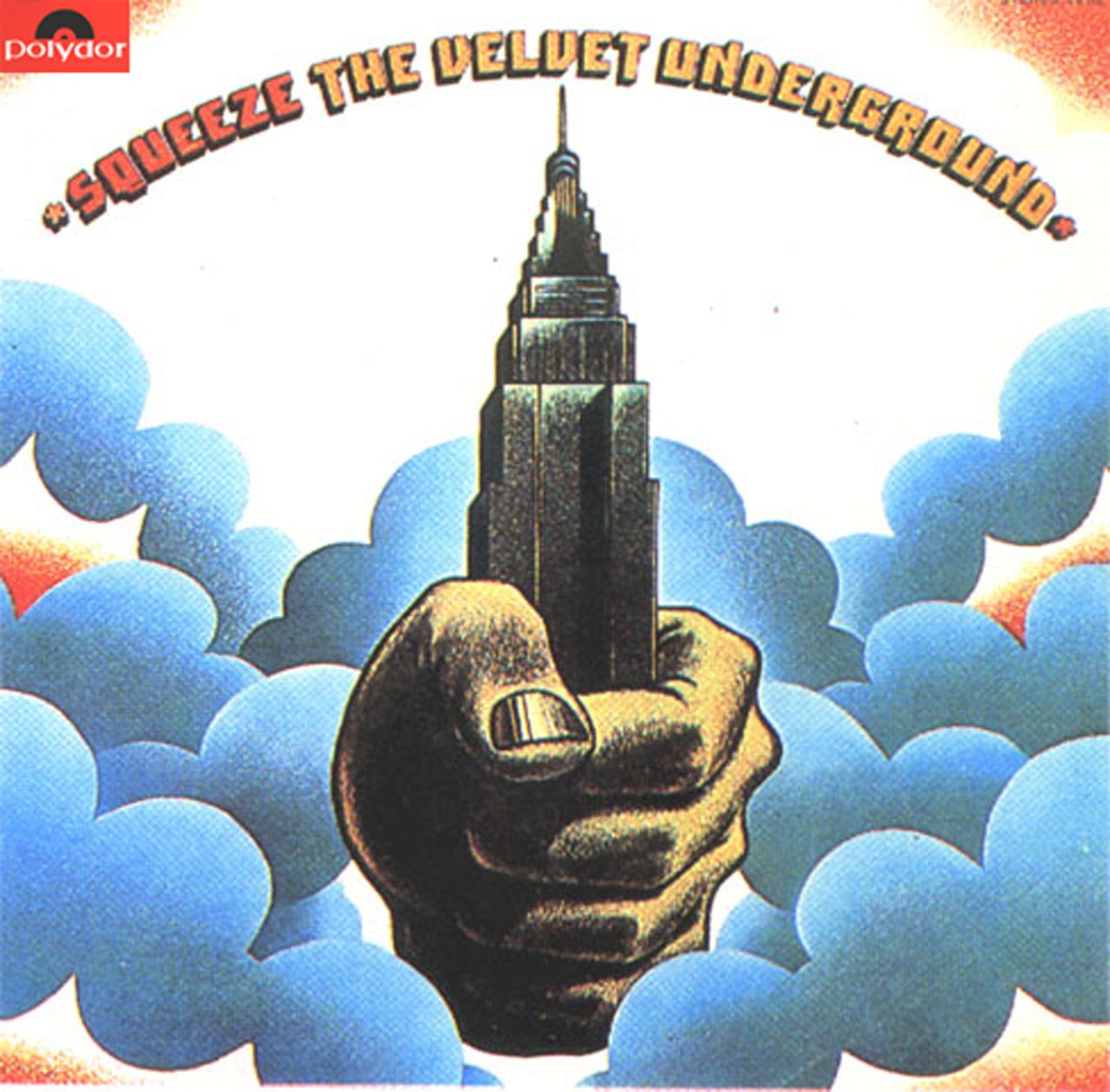
The Velvet Cloak-and-dagger: Squeeze (1973)
"Clasp" is a footnote in the annals of music history. Although information technology was released under the legendary imprimatur of the Velvet Surreptitious, information technology only features one member of the bodily group: Doug Yule, a multi-instrumentalist who didn't join the grouping until after the release of their second anthology. The resulting piece of work, "Squeeze," found picayune commercial or disquisitional success. Unlike the canonical Velvet Underground albums, this i is largely gratis of disharmonize, irony or venom, as if someone had squeezed the life out of the band.
Ane loftier signal of "Squeeze" is the anthology cover. The illustration is similar, stylistically, to the comprehend of the Velvets' 1970 album, "Loaded," which depicted pinkish fume emanating from a New York City subway stairwell. Symbolically, though, the imagery could not be any more dissimilar. No longer an emanation from "underground," "Squeeze" announces itself as a beacon from the heavens, grabbing New York City by the neck, i.e., the Empire State Building. The hand pictured could belong to Yule, every bit if, against all odds, he has taken hold of the band — and he isn't letting go.

Via Architizer
In 2011, the Canadian band Azari & Three riffed on the imagery of "Clasp" for their self-titled debut album. The giant disembodied hand in their illustration grasps the Burj Khalifa, an icon of ability and prosperity in the era of globalization. Referencing "Squeeze" in a debut was an interesting selection on the part of Azari & Three, given the album's ambivalent reputation. Expert pattern, all the same, is good pattern, and this anthology embrace is every bit as striking as its predecessor. At that place is something eerie nearly the manicured manus in this image: Its loose grip somehow seems more than menacing than the squeezed fist on the Velvets' cover.

Via Wikipedia
Meat Loaf: Bat Out of Hell II: Back Into Hell (1993)
To honey Meat Loaf — the food or the recording artist — is to embrace maximalism. Guitars scream, pianos whirl and Meat Loaf howls throughout his 6th album, "Bat Out of Hell II: Back Into Hell," which consists almost entirely of neo-Wagnerian ballads that reach for all the highs of popular music while stubbornly refusing any of the lows. Similar a well-salted homemade foodstuff, the album leaves listeners feeling exhausted, oddly greasy and peckish a glass of water. It's much more American than apple pie; it's as American every bit Oreos.
The embrace image, created by the sci-fi/fantasy illustrator Michael Whelan, features a gigantic bat perched atop the Chrysler Building holding an innocent Valkyrie hostage. Luckily, the monster is about to meet his match in the form of a flaxen-haired hero who rides a flying motorcycle and clutches a ball of low-cal. Like the album itself, the charm of this image lies in its emancipatory shirking of restraint. There is some kinship between Meat Loaf's aesthetic and that of the Chrysler Building, that jewel of the Manhattan skyline that embraces decoration for its own sake. In compages, like life, we often look for rest, restraint and utility. Other times, however, it'south best to "just pray to the Gods of Sexual practice and Drums and Rock and Roll," as Meat Loaf understands so well.

Via Wikipedia
Drake: Views (2016)
Canada loves Drake, fifty-fifty more than the rest of the earth. It was not surprising, then, that the melancholic rapper featured the CN Tower, a swain Toronto icon, on the comprehend of his 4th studio album, "Views." In this prototype, Drake can be seen sitting atop the CN Belfry, legs dangling perilously off the edge. The clouds, like Drake's troubled thoughts, are dark and gray, and like the lukewarm reviews that would follow the album's release, they loom closely behind him. Indeed, many of the anthology's lyrics seem to anticipate the rapper'due south imminent fall from critical grace. In the single "Hotline Bling," Drake grasps nostalgically, even pathetically, at a memory of adoration lost, haranguing a woman who "used to call [him] on [her] cell phone."
If you mind closely, it becomes apparent that what Drake is really getting at with this record is an understanding that change, fifty-fifty bland change, is painful for homo beings. The embrace'southward juxtaposition of his own tiny, delicate corpus with the mighty tower that supports it is an expression of human impermanence, a feeling that is familiar to anyone who spends time contemplating iconic architecture.

Via Wikipedia
Unknown Mortal Orchestra: Unknown Mortal Orchestra (2011)
The Petrova Gora Monument, which appears on the cover of Unknown Mortal Orchestra'south debut album, commemorates 300 Serbs who died resisting the Axis-aligned Ustaše militia during Earth State of war II. It stands at the highest elevation of Petrova Gora, a mountain range in nowadays-day Croatia. The monument, which was designed by Vojin Bakić and completed in 1981, now stands in a state of disrepair. The museum inside is no longer operational, and many of the planks that make up the stainless steel façade have been stolen. All the same, there is a kind of quiet, albeit awkward dignity to this futuristic Soviet-era structure that no amount of vandalism can strip away. Standing alone in the countryside, the monument does not immediately announce its purpose, lending it an otherworldly air.
The alien quality of the structure is what recommended it to Unknown Mortal Orchestra, an American and New Zealand psychedelic rock band that likes to cultivate a sense of mystery itself. "I liked the idea of this mysterious edifice that you don't know what it is or where it is, simply it's from the past, congenital for the futurity, and is now in busted," explained ring member Ruban Nielson. "Information technology seemed to match the music, so we used an image of that that looked like a tourist photo."

Via Wikipedia
Pocket-sized Mouse: The Lonesome Crowded Due west (1997)
Modest Mouse are America'southward respond to Radiohead: a witty, observant, sometimes paranoid group who chronicle the emptiness and dissatisfaction people face in our highly commodified, media-saturated societies. "The Lonesome Crowded West," the band's second full length, is darker and in some ways less polished than the better-selling albums that would follow, simply in this reporter'southward humble view, information technology is by far their greatest achievement. More than than any other artwork I know of, this album captures the sense of openness one finds on long drives through rural America, a feeling that is paradoxically both exhilarating and burdensome.
The photographs on the album sleeve, fittingly, are taken from the depression vantage point of a car window. The buildings captured in these images are the towers of the Westin Seattle: cylindrical, international style diplomacy erected in 1969. Posed against a purple evening sky and nestled within a black frame, these towers take on an effect of incommunicable distance on the album cover. We relate to them in the same fashion a truck commuter relates to the many cities he passes through before arriving at his destination.

Via Wikipedia
Nas: Illmatic (1994)
One of the most iconic album covers of all fourth dimension, the sleeve for Nas's "Illmatic" features a semi-transparent childhood portrait of the rapper superimposed over an image of a New York City block. The child and the social environment that formed him are thus depicted as totally entwined, a fact with important resonance given the harrowing vision of urban life Nas presents in his songs.
For the album encompass, Nas was very deliberate in choosing a photo of himself at historic period seven. "That was the year I started to admit everything [effectually me]," he explained in a 1994 interview. "That's the year everything set up off. That'south the year I started seeing the futurity for myself and doing what was right. The ghetto makes you remember. The world is ours. I used to think I couldn't go out my projects. I used to recall if I left, if anything happened to me, I idea it would be no justice or I would exist just a dead slave or something. The projects used to be my world until I educated myself to see there's more out at that place."
Since its release, this anthology cover concept has been discipline to numerous parodies and appropriations. None of this, however, has blunted the power of the original. Like any iconic epitome, this i has seeped into the very fabric of our civilisation.

Via Wikipedia
Mazzy Star: She Hangs Brightly (1990)
In addition to having 1 of the nearly memorable architectural album covers of all fourth dimension, Mazzy Star'southward debut album, "She Hangs Brightly," is distinguished past existence one of the all-time albums ever recorded. The first two tracks, "Halah" and "Blue Flower" rank with the about poignant, perfectly balanced beloved songs in history, mixing the unequalled, languid vocals of Hope Sandoval with the psychedelic guitar work of Dave Roback. Fifty-fifty Kurt Cobain listed this as one of his top 50 albums of all fourth dimension.
The anthology comprehend is almost as elegant as the music inside, featuring a photograph of the interior of the Art Nouveau Hotel Tassel in Brussels. In that location is something about the 1990s that seems to gel with Art Nouveau aesthetics. Maybe it was our own Belle Époque. Seriously, though, if yous take not heard this album yet, please head to your nearest Spotify immediately to rectify that situation. Ameliorate yet, do what I did and purchase information technology on 180 gram vinyl. You will not be disappointed, but y'all might cry. A lot.

Via Facebook
Yeah: Going for the I (1977)
The Century Plaza Towers in Los Angeles were designed by Minoru Yamasaki, the architect best known for designing the Twin Towers of the World Trade Eye in New York. Like the Twin Towers, the Century Plaza Towers follow Yamasaki'south "New Formalist" principles and are thus marked by strict symmetry and an understated, classical sense of grandeur. Different the Twin Towers, these buildings have a unique, triangular footprint, a fact that tin can be somewhat unsettling to visitors accepted to rectangular buildings.
The slightly jarring, angular effect of these buildings is exaggerated in the cubist rendition of the towers featured on the cover of Yep's 8th studio anthology, "Going for the Ane." The nude man in the foreground of this prototype is facing an impossible scene, a mess of jutting, intersecting planes that feels like something out of Rem Koolhaas'south "Delirious New York." The image nearly seems to repeat Yes'southward songwriting method, which some critics at the time compared to a "kitchen sink" in which multiple elements were thrown together haphazardly, without beingness successfully integrated. Perhaps Yes intended this cover to be a commentary on this criticism of the band. In whatever case, the prototype is appealing in itself, a winning composition of blue, orangish and white that even Yamasaki could appreciate.
Via Wikipedia
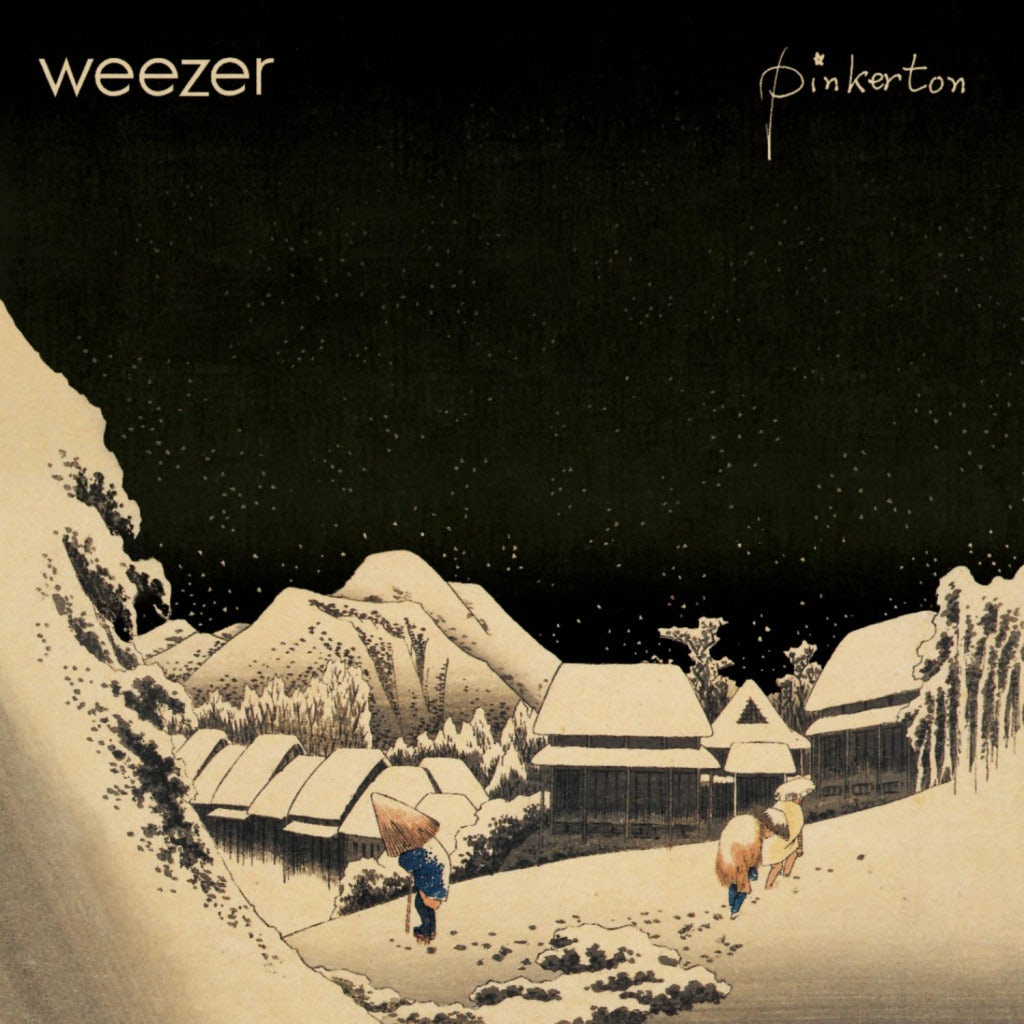
Weezer: Pinkerton (1996)
Westerners tend to run into Nihon through a romanticized lens, a tradition that stretches from Puccini's 1904 opera "Madame Butterfly" to the most recent season of HBO's "Girls," in which Shoshana, a grapheme played by Zosia Mamet working abroad in Japan, mentions to a friend that she loves the country and so much she sometimes worries that she "made it up." Weezer picked upward this theme in their 1996 anthology "Pinkerton," a loose concept album based on "Madame Butterfly" that focuses on the fashion idealism leads to despair. In songs like "Why Bother?" and "Pink Triangle," singer Rivers Cuomo confronts the fact that he finds himself heartbroken every time he gets his hopes up.
Laced throughout this album, nighttime past Weezer's standards, is an idea of Japan as the home of innocence, imagination and idealized, inaccessible fangirls. The album cover features a 19th-century woodblock illustration by Hiroshige called "Night Snow at Kambara." The traditional Japanese houses in the background, roofs blanketed by snow, present a picturesque image of a Japanese village. The contrast between the serenity of this image and the noisy opening to the album's first runway, "Tired of Sex," echoes the gulf between fantasy and reality that the anthology explores so memorably.
For a critical accept on the Western tendency to romanticize Asian cultures, check out Edward Said's landmark 1978 book "Orientalism," in which he explores how these types of attitudes are connected to the legacy of colonialism.

Via Wikipedia
The Magnetic Fields: The House of Tomorrow (1992)
This is the only entry on the list with a title amend suited to an compages exhibit than an album. An EP, this record clocks in at only 12:21 simply contains some of the Magnetic Fields' all-time songs, including "Love Goes Home to Paris in the Leap." Both the title of this EP and its cover art — a colorized photograph of the 1904 St. Louis Earth's Off-white — reference the utopianism of the early 20th century, a fourth dimension when the future was contemplated with hope rather than dread and an architectural exhibition could keep the printing busy for weeks.
The subtitle of the EP is "five loop songs," pointing to the fact that each of the tracks consists of a unmarried, repeated loop. Like a designer of modular homes, songwriter and multi-instrumentalist Stephin Merritt is cracking to show off how much he can do with absolutely minimal component parts. The utopianism in the championship stands in ironic contrast to the sardonic, frankly depressed content of the songs. Sample lyric: "Every time y'all feel wonderful, baby, I feel bad / Either I don't love you or yous don't love me, oh aye."

Via Wikipedia
Sufjan Stevens: Illinois (2005)
The 2d entry in Sufjan Stevens' quixotic, perchance ironic "50 states" series, in which Stevens promised to create a concept album for each united country, "Illinois" is 1 of the well-nigh ambitious works of the aughts. In nearly every song, Stevens walks a razor-thin line between whimsy and heartbreak, nestling devastating songs similar "Casimir Pulaski Twenty-four hours" and "John Wayne Gacy" within an overall conceptual framework that involves children's choirs and song titles like "They Are Night Zombies!! They Are Neighbors!! They Have Come Back From the Dead!! Ahhh!" During the tour for the album, Stevens would habiliment a male child picket uniform and butterfly wings onstage. Stevens' appetite to fuse an appreciation for kitsch Americana with a respectful interest in the lives of ordinary Americans is something few others would have thought of and even fewer could have pulled off with any sort of success.
The cover fine art for this anthology matches its sensibility perfectly. A crowded, mural-like portrait featuring the Chicago skyline, UFOs, Al Capone and a goat, this paradigm reflects an image of Illinois as a land suffused with sociology. One of the strongest aspects of the illustration is the irregular, felt-tip rendition of Chicago's skyscrapers. Rendering these awesome towers in an non-expert hand makes them appear folksy and familiar, reminding us that these buildings class the properties of Chicagoans' lives. "I was in love with the place," Sufjan sings of America's first city of compages, "in my mind."
Fun fact: The original album sleeve featured an image of Superman. This was removed in subsequent printings after Stevens' label, Asthmatic Kitty, became enlightened that using Superman's prototype in this mode constituted copyright infringement.

Via Wikipedia
Pink Floyd: Animals (1977)
Loosely based on George Orwell's archetype novella Animate being Farm, Pink Floyd's "Animals" depicts class society as various types of animals: sheep, dogs, pigs and "Pigs on the Wing." At turns dreamy and depressing, "Animals" is the production of a ring with nothing left to prove, who are able to put aside distractions and focus on crafting a work that perfectly matches their vision. The photograph on the cover features the Battersea Power Station in West London. Something near the composition makes it look impossibly enormous, an impenetrable fortress of industrialism reminiscent of the Ministry buildings in Michael Radford'southward motion-picture show accommodation of "1984." The icy construction is offset a bit by the whimsical epitome of a flying sus scrofa.
Fun fact: The original programme for the album fine art included a giant, pig-shaped helium balloon. The idea was to accept a photograph of the power station with the pig floating in forepart of it. Unfortunately, on the day of shooting, the helium balloon escaped. The pig flew through Heathrow airspace, forcing the cancellation of flights and eventually landed in a nearby farm, ironically frightening a flock of sheep. Because the balloon plan failed, the prototype of the squealer that appears on the album sleeve was simply superimposed on a photo of the factory.

Via Pitchfork
Baio: The Names (2015)
Baio is the stage proper name of Chris Baio, the bassist of Vampire Weekend, a ring comprised of Columbia University alumni that stormed into the public consciousness in 2007 with a set of catchy, Afrobeat-inflected songs virtually Cape Cod and Oxford commas. Baio'due south debut solo anthology, "The Names," takes its title from a Don DeLillo novel, following in the proud Vampire Weekend tradition of having good taste. Baio's sophistication is seen most markedly in the sleeve for "The Names," which features a photo past Matthias Heinrich of a building in Hamburg.
"I came across him on pattern weblog about five years ago," Baio said of Heinrich in an interview with The Spaces. "To return to that idea of estrangement, Matthias takes pictures in Berlin and Hamburg — where the one I used for the album artwork was shot — and my experiences of those cities have ever been extremely grey, so to meet insanely colorful photos taken there fascinated me."
As the interview continued, Baio came effectually to the subject of the font featured on the sleeve. "[This] is from the opening sequence of the Ingmar Bergman movie, 'Persona,'"he explains. "Information technology's probably my favorite five minutes of whatsoever movie ever." Design fans should exist happy to larn that Chris Baio is 1 of their own. Information technology doesn't hurt that the songs on this tastefully appointed debut are as infectious as the anthology art. "Sis of Pearl" was stuck in my head for a skilful week when it was released concluding summer.

Via Wikipedia
Wilco: Yankee Hotel Foxtrot (2002)
The story of Wilco's fourth anthology, "Yankee Hotel Foxtrot," is told time and again. Completed in early 2001, Wilco's label, Reprise Records of Warner Music Group, originally refused to release information technology, believing the art rock production was too experimental to entreatment to a mainstream audience. In response, Wilco pulled out of their contract and decided to stream the anthology on their website for costless, a pioneering motility in these early on days of file sharing. Eventually, Wilco was able to accommodate for the official release of their album through Nonesuch Records, a different Warner imprint, in April 2002.
Streaming of "Yankee Hotel Foxtrot" began on September xviii, 2001, only one week afterwards the attacks of September xi, which happened to take been the original scheduled release date of the album. Fans immediately made connections between the album's artwork — which features the two towers of Marina City in Wilco'south hometown of Chicago — and the Twin Towers of the World Merchandise Centre. Furthermore, lyrics such every bit "Tall buildings shake / Voices escape" and song titles like "War on War" reminded listeners of the attacks. While coincidental, these connections were all felt as poignant to listeners, who interpreted the anthology as a meditation on life in uncertain times.
The album's thin product — which features a generous corporeality of radio static — and abstract lyrics all contribute a mood of vulnerability nigh anyone tin can relate to. In this context, the elegant towers on the cover take on a more than intimate meaning. Like usa, they look lost, framed only by a blank insensate sky. "Oh distance has no way," Jeff Tweedy sings, "of making honey understandable."
Architects: Showcase your next project through Architizer and sign upwards for our inspirational newsletter.
Source: https://architizer.com/blog/inspiration/collections/top-15-album-covers/
0 Response to "This Is Me Album Back to Back Cover Art Drake"
Post a Comment